
Why So Many Nonprofits Get Stuck in the Start-Up Phase
Hope you and yours are well and found some time to reflect on gratitude in these challenging times. In case you were wondering, yes, I did make the Yummy Sweet Potato Casserole and it was as good as I remembered it! As much as I am focused on expanding the pie and collaborative advantage, it may have been the best thing I ate at Thanksgiving. Not sure. What did you enjoy?
We are continuing our series on the Nonprofit Lifecycle by exploring the Start-up Phase.
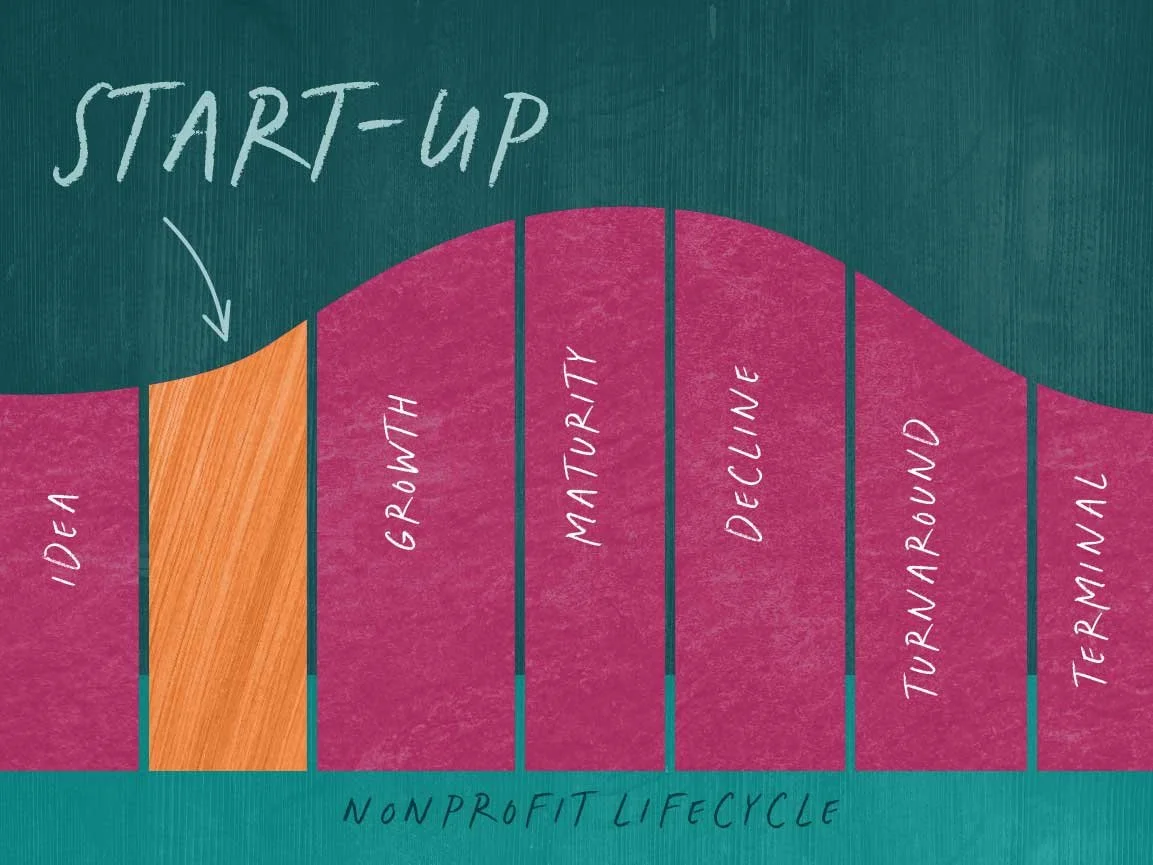
ID: Dark green background, a bell curve mountain labeled Nonprofit lifestyle. The stages are Idea, Start-up, Growth, Maturity, Decline, Turnaround, and Terminal. The second stage, Start-Up, is lit up orange.
The Start-Up phase occurs when an organization moves out of the Idea phase and begins serving people. Leaders decide to take the risk of opening for business.
Most Nonprofit organizations do not grow past the Start-Up Phase
A 2019 study counted 92,567 active nonprofit organizations in California. Of those, 65,250 (70%) are all-volunteer organizations. Those are in the Start-Up phase! Only 30% of these organizations (27,317) have a large enough budget to hire paid staff. National data is similar.
So what is a Start-Up? How does the organization work and why are there challenges to growth?
A Start-Up nonprofit is a low-budget organization with little or no staff
A Start-Up organization may be fiscally sponsored or may have acquired 501(c)(3) status. The organization’s funding is low-budget: Most likely under $100,000 yearly, and possibly close to zero. Funds may come from one grant or a small group of donors.
With limited funding, Start-Up organizations have little or no staff. The work of the organization is mostly done by volunteer board members, who spend long hours working on the mission of the organization. The term “working board” is often used to describe these board members.
Leaders from many Start-Up organizations join the Cal State University East Bay Nonprofit Management Certificate program courses. For example, Janet Noble-Maxwell, a co-founder of the Friends-Stewards of the African American Museum & Library at Oakland (FSAAMLO), joined the Board Development course earlier this year. The purpose of the Friends-Stewards of AAMLO is to “provide community awareness, educational and research opportunities; and to preserve, interpret, and share the historical and cultural experiences of African Americans in Oakland, and Northern California for present and future generations.” According to recent tax filings, the yearly budget of FSAAMLO has ranged from zero to $16,000.
If the term “Start-Up” suggests that the organization was established recently, it may be a bit misleading since many organizations remain in this phase permanently! In the Nonprofit Lifecycle model, Start-Up is focused less on time and more on organizationalmaturity.
Low-budget and with energy and passion for the mission
While most Start-Up organizations have little or no staff, volunteers have energy and excitement for the work. FSAAMLO was created in 2018 by a group of friends who wanted to honor and amplify the history and culture explored by the African American Museum & Library at Oakland. Board members, most of whom are currently retired or close to retirement, find it meaningful to collaborate and work on the mission together. According to Noble-Maxwell, co-founders have been “steadfast and committed to the mission.”
Most Start-Up organizations are characterized by a lack of systems and clear roles. In this stage, there is “more work than people,” which means anyone who feels moved by the mission and has the bandwidth is invited to step up and contribute.
The challenge of Start-Up: sustaining and expanding the energy
Looking at the image above, organizations in the Start-Up phase are headed up a slope. There is challenging work ahead.
It can be energizing and meaningful to build a new organization. And it hurts, literally, if volunteers struggle to find others who share their passion for the cause and also want to contribute.
After many years of volunteering, the founding generation of board members of many Start-Up organizations may tire and move on to other interests. Leaders must recruit a new generation of board members or raise funds so that the organization can employ paid staff or risk the organization dissolving entirely.
Although Start-Up organizations do not need to create a full strategic plan, some Strategic Planning, such as creating high-level goals for funding, program, and staffing or board recruitment, helps leaders to make decisions, get alignment, and move to the Growth phase. If a Start-Up is not able to clarify and prove its business model and program model, the organization may move towards decline.
In that mix of initial gumption and motivation along with enough experience and planning, Start-Up organizations can have a fighting chance of surviving and continuing to serve their missions for extended periods of time. That can fuel the organization, driving it past the tipping point beyond Start-Up and into the Growth phase. There, it is then faced with a whole new set of challenges, which we’ll explore in the next part of the series. For now? I have a few bites of this leftover Sweet Potato Casserole to get to.
What has been your experience working with or at Start-Up organizations?
All posts in this series: