
How embracing my deepest values led to a viral moment
How are you?
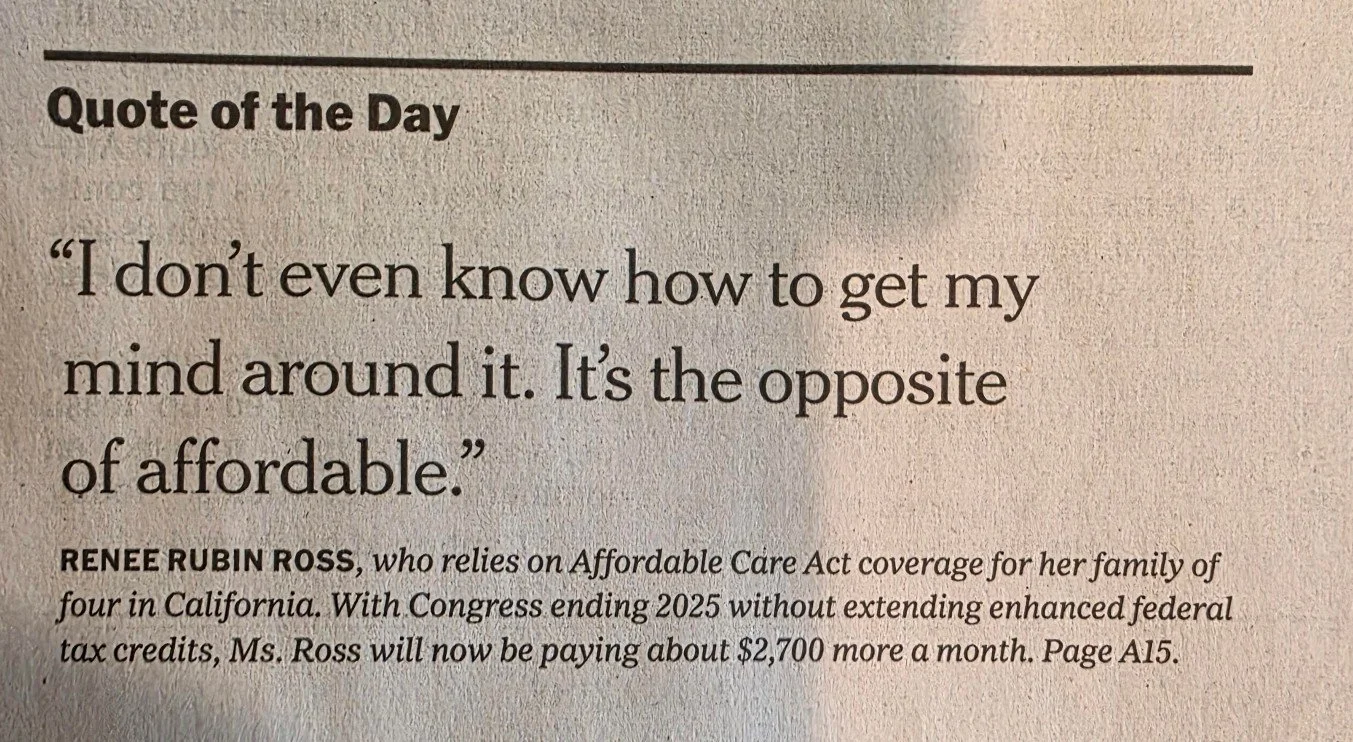
Over here, it has been an intense few days. Last week, our family’s story about ridiculously rising healthcare costs was featured in the New York Times. A quote from the article was selected as the NY Times Quote of the Day.
That felt like a pretty big deal!
Then, I received an inquiry from a producer at MS NOW Weekend Primetime about being interviewed on their live national broadcast. On Sunday, I had the opportunity to share our story briefly with a national audience. Here’s the video if you want to watch.
That felt like an even bigger deal! I was nervous to be interviewed on live national television – I imagine you would be too! I feel proud that I shared our story in an authentic way.
In the past few days, it has been so moving to hear from people around the country thanking me for speaking up and expressing support, solidarity, commiseration, frustration, and anger. I know that we are not alone and that many millions of Americans are facing these unreasonable costs, which was why I chose to speak up.
Before reaching out to the New York Times, I thought about whether I wanted to put my family in the spotlight. I went back to my deepest values to think about this.
Here are three key ideas that informed my decision to speak up, guide the work of The Ross Collective and should inform how your organization expresses leadership as well.
We must move towards a society, and organizations, in which all people can thrive
We have been writing on the idea of Collective Enoughness and the Abundant Shared Future for a while. In terms of healthcare, research indicates that countries with universal healthcare tend to be healthier, with higher life expectancies, better chronic disease management, and greater overall well-being. Capitalism points us towards individualism, but there’s another way: Our futures as citizens of our nation and planet are tied together.
Most of the organizations we work with are working towards building organizations in which all people thrive. This includes increasing salaries, strengthening benefits, and strengthening team dynamics among the staff. This feels good and supports recruitment and retention.
Speaking up is a way to build community and create hope
Back in November, when I first saw the potential cost of healthcare for our family, I felt a sense of despair. Then I thought that there must be others talking about this. A form on the New York Times website to share our experience led to being interviewed and featured in the article.
Speaking out, doing something, and finding others who are working towards solutions creates hope. It’s so important to speak up about challenges that impact many of us. The crisis of healthcare affordability is a societal, not individual, problem. I choose to speak up because I know that many millions of Americans are in a similar situation – or far worse. Part of my purpose is to talk about how widespread this issue is and to encourage people to take action.
As we have shared in the past, courageous leaders need to “Be a megaphone, not an ostrich.” As I wrote last year, “Because many people are feeling uncertain and anxious, it is more important than ever to speak loudly and honestly about the good work you are doing! If you have hit challenges around funding, you can share that too.“ I guess I took my own advice!
We need more financial transparency and less shame around money and finances.
There’s a stigma around not having enough money for food or basic needs such as healthcare. But when millions of Americans can’t pay for these basic needs, something is wrong and we need to stop blaming the individual and move towards a society of prosperity for all -- not a greedy stockpiling by a few billionaires.
That is another reason we talk about money and the financial situation of the organization when we do strategic planning. A fiscal review is always part of the planning process as a way to be more transparent about finances, increase the team’s financial literacy, and ground decisions in the facts about expenses and revenue.
So to summarize, here are three questions that point each of us towards leadership at this challenging time:
How are my actions building a society in which all people thrive?
How can I speak up courageously about the challenges I see around me – and encourage others to do so too?
How can I be more transparent about money and finances?
Do these questions resonate with you? What questions are guiding your actions now?
I have to say that the personal excitement about having a quote in the NY Times and being in the national spotlight, if even for a few minutes, is pretty amazing. This is an issue that directly impacts nonprofits, local governments, and small businesses as it has caused costs to increase for so many of us. In 2026, I’m going to keep speaking out about this alongside our work of Inclusive Strategic Planning, and being a parent, partner, and business owner. Thank you for being on the journey with us.