
Three factors that support a successful nonprofit Turnaround
For those of us who work with nonprofits, hearing about an organization that “didn’t make it” and had to close its doors is similar to driving past an accident on the highway.
We don’t want to look away from the damage. It’s human nature to slow down and stare, and we’re wired to wonder, “What happened? Is everyone all right? And how can we avoid that happening to us in the future?”
Here’s where things get real—and very applicable to our current day as we continue our series on Nonprofit Lifecycle with the Turnaround stage.
And the very real question to ask is this: Why are some nonprofits able to Turnaround—and others are not?
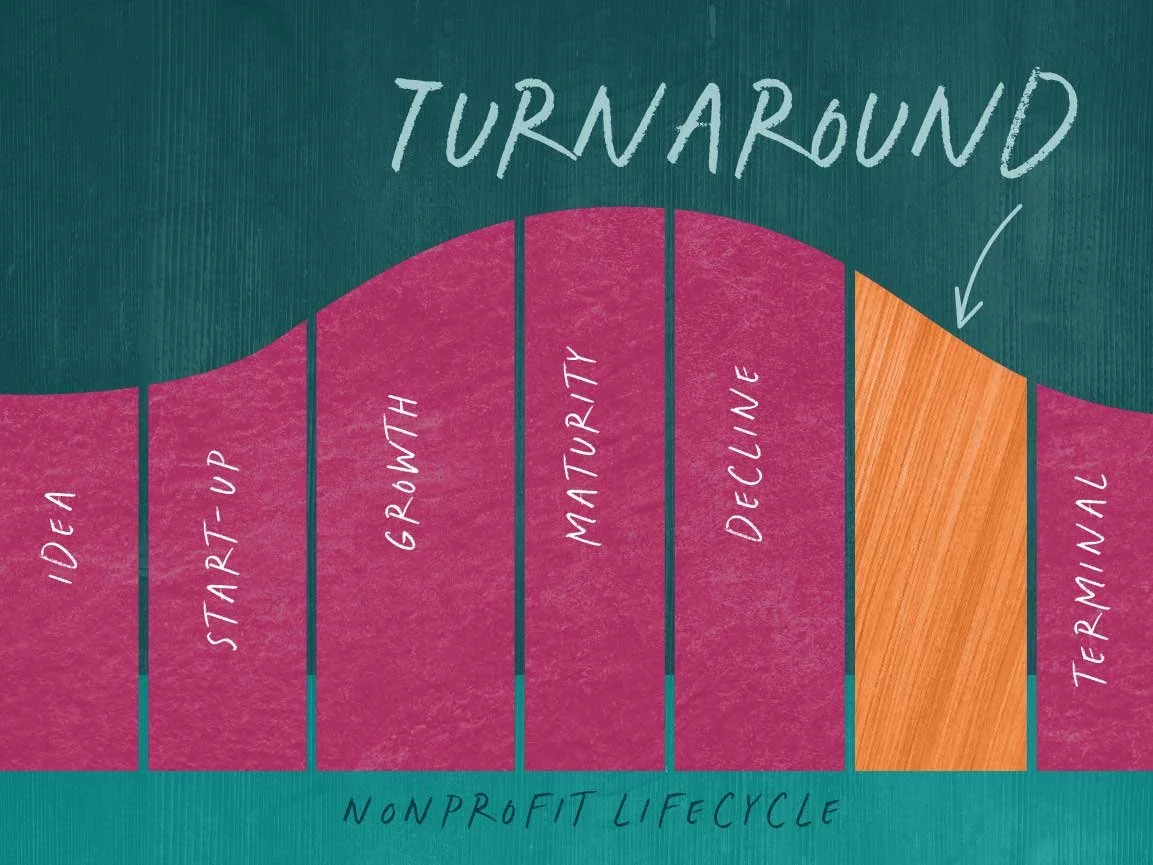
The Nonprofit Lifecycle with Idea, Start-up, Growth, Maturity, Turnaround, Terminal all in pink, and Terminal highlighted in orange
The fate of many Northern California arts organizations after the pandemic
In early 2020, everything was “normal”... until it wasn’t. With the announcement of a worldwide pandemic, everything shut down and people sheltered in place until a vaccination was widely available. (I probably don’t need to remind you of this; it’s both recent memory and seems like ages ago for many of us.)
As cultural institutions, arts organizations pride themselves on being spaces where people gather in person, making them among the hardest hit. Some had to close for a whole season or more, losing all of their ticket revenue.
After the pandemic, audiences returned slowly, but a number of arts organizations did not survive.
One example is Bay Area Children’s Theater (BACT), a beloved Northern California Bay Area theater company that produced wonderful theater productions for young children and families. BACT built their audience, reputation and work over 19 years, until the surprising announcement in 2023 that they had run out of funds and would be closing immediately.
Sadly they were not alone. Several other East Bay Area arts organizations, such as Aurora Theater and CalShakes have closed over the past few years, citing similar funding challenges.
But what of those arts organizations that did survive?
Berkeley Repertory Theater (“Berkeley Rep”) was also hard hit by the pandemic, including losing 75% of its ticket revenue and having to lay off many members of the staff. Then-Managing Director Susie Medak described this period (2020-2022) as a “ghastly” time.
Berkeley Rep made it through this period and is now towards the end of a full season of theatrical offerings. (Full disclosure: I serve as an usher for Berkeley Rep productions. My analysis for this post draws only on publicly available information.)
How was Berkeley Rep able to survive, when others were not? Medak explained that Berkeley Rep “would not have survived without receiving government funding.” But based on what we know about nonprofits, that isn’t the whole story. Other arts organizations also received government funding, and it wasn’t enough.
Three factors that support a nonprofit Turnaround
In our last post, we discussed steps to take in the Decline stage, including determining whether the mission is still compelling, identifying individuals who want to work on that mission, and “enacting dynamic, coordinated strategies in order to shift the current direction and move toward Turnaround.” But how?
Here are three factors that support a Turnaround. These factors are always important, even in the best of times. As times get more difficult and budgets tighten, they become even more critical.
Good leadership
In challenging times, organizations need excellent leaders who balance a focus on what matters most (including carefully tracking finances), communication with the community, and a persistent determination to leave no stone unturned to keep the organization alive.
Ironically, in a crisis, good leadership may not feel good—it actually may feel quite distressing, as Susie Medak describes in the article. That’s because leadership in a crisis involves making some incredibly difficult decisions.
When I talk about leadership, I do not mean one person. One person may be the guide AND hopefully that person is supported by a board and staff team who are expanding the organization’s influence and opportunity and are as invested in its future.
Creating a reserve and scenario planning
Very few of us were expecting, let alone planning for a worldwide pandemic. That being said, some organizations started off in a better position because they had a reserve to draw on. Creating a financial reserve is a measure of organizational strength.
In determining whether to spend the reserve, scenario planning is helpful. Leaders should discuss possible scenarios and come to agreement about the steps they will take as finances and cash flow shift.
In the midst of a crisis or decline, it may feel that there is no time for planning. The fact is, in a more challenging time, it is that much more important to draw on different perspectives and create alignment for next steps. I share the steps to do this in my recent book.Good luck—or bad luck
Good luck or bad luck figures into why some organizations survive and others don’t. The pandemic hit arts organizations much more than some social services organizations.
It is important to state that there is not a connection between doing excellent, community- or client-focused work and making it through a financial crisis. In these moments, the challenge is to keep the program strong and stabilize and strengthen finances.
So yes, there’s luck… but there is also leadership development and strategic planning that will make it more likely that an organization will survive.
That’s the work we do with the organizations who hire the Ross Collective, where Turnaround is something we’ve witnessed, as we’ve supported organizations to move through it towards stability.
If you want to learn more about strengthening your organization throughout the Nonprofit Lifecycle, reach out. We are not in a pandemic (thank goodness), but as we face these uncertain times, we are leading strategic planning or scenario planning to build alignment and keep organizations strong.
All posts in this series: