
How to recognize the nonprofit Decline stage - and how to fight back
“I think you have the wrong information!” said Joanne, the board vice president, in an irritated tone.
“Yeah,” agreed Barbara, the board secretary. “You’re bringing us this framework of nonprofit Decline, but that can’t possibly apply to us! We’re our own organization! You can’t just bring in this generic thing and tell us it’s about us.”
Well, this was something. After thorough research, I’d just presented my findings proving my suspicion that their organization was in the stage of nonprofit Decline… and they didn’t believe me?
Let me back up.
A few years ago, The Ross Collective received an inquiry from Karl, a board member seeking to do strategic planning with his organization.
Within the first few minutes of our conversation, I suspected that the organization was in the Decline stage.
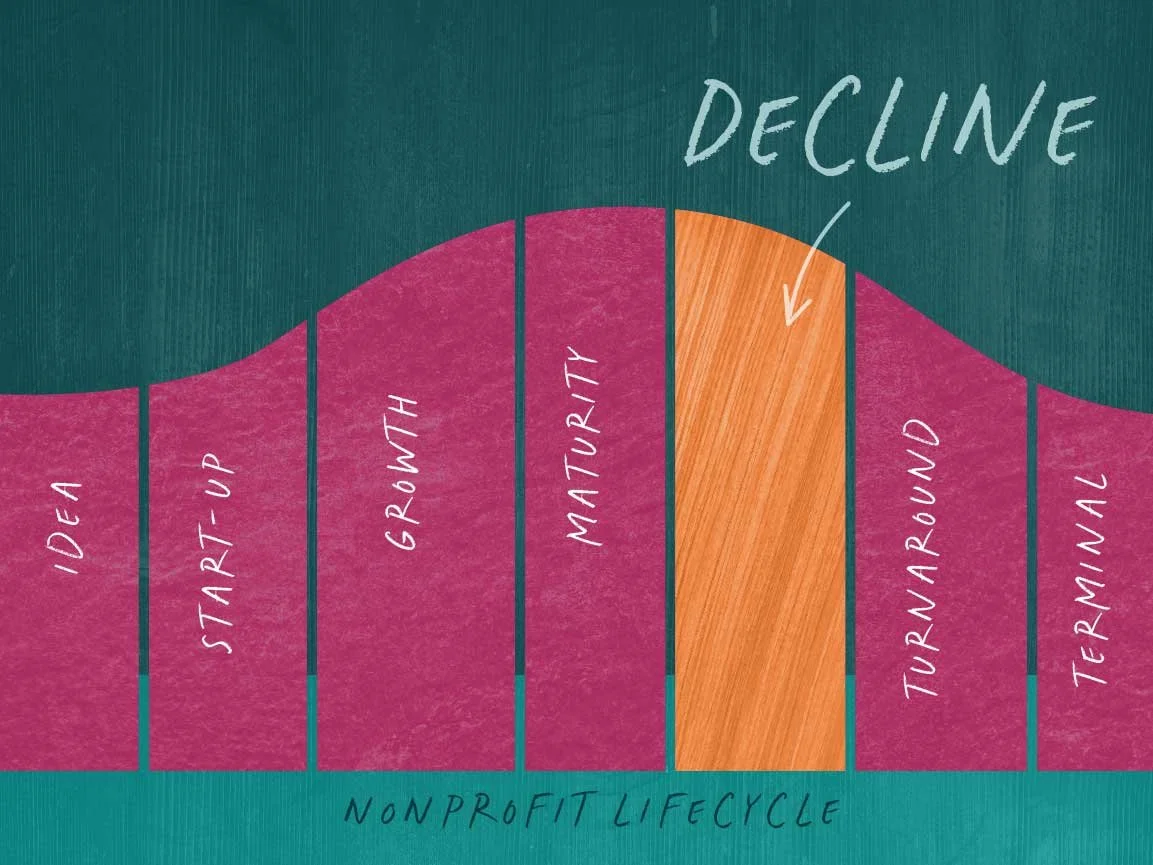
The Nonprofit Lifecycle with Idea, Start-up, Growth, Maturity, Turnaround, Terminal all in pink, and Decline highlighted in orange
Here were some clues:
Several key staff had left the organization over the past few years, and the organization had not hired permanent replacements
The budget of the organization had decreased
The program activity of the organization had decreased
The organization had instability around their facilities and had to move locations several times
I let Karl know that I thought the organization might be in the Decline stage. I suggested that we do some discovery work and facilitate a conversation with staff and board members about next steps.
Our discovery work included focus groups and interviews that confirmed my initial impression. I wrote up a brief Discovery Report that explained our findings, including an explanation of the Decline stage and the data that indicated the organization was in Decline.
And when it came time to present my findings to the board and staff, a number of board members, like Joanne and Barbara, were (understandably) upset. They did not like hearing the word Decline and facing what was happening.
Decline must be faced to be corrected
As this story indicates, it often does not feel good to acknowledge that an organization is in the Decline stage, especially when staff, board members, and volunteers have been connected to the organization for many years.
But leaders must acknowledge that they are in the Decline stage in order to figure out how to go forward.
Three key steps for responding to Decline
There are three simple steps to respond to the Decline stage. Note that these are simple, but not necessarily easy:
The first step is to consider: Is the mission of the organization still compelling to the community? How can you answer this? By having a conversation with leaders and community members to discuss this question and get a clear answer.
If the mission is still compelling, the next step is to determine whether there are individuals who want to work on this mission. Again, the group needs to find out whether board and staff members are willing to step forward to work on the mission.
If individuals want to work on the mission (either the current leadership or a new group), these leaders must enact dynamic, coordinated strategies in order to shift the current direction and move toward Turnaround.
Things got worse before they got better
So what happened with Karl, Joanne, and Barbara?
In that hard conversation about Decline, I shared my analysis. While Barbara and Joanne didn’t want to accept the findings, others in the room agreed with me.
I asked whether leaders felt that the mission was still compelling, and many of them said they did. Many also said they felt deeply connected to the work and were willing to do what was needed in order to shift direction.
At this point, another staff member announced her departure, and the board decided to pause our planning work, further entrenching them—for the time being—in Decline.
This story has a happy ending
As I was writing this post, I visited the organization’s website, which I hadn’t visited for a few years—and was amazed.
As it turns out, the organization found a much more suitable facility and had some funds to purchase it. This change created organizational stability. From that point, board and staff leaders were able to recruit some key executives that brought new energy to the organization. It seems that they have completed a successful Turnaround.
I honestly didn’t know what direction things were going to go when I reported my findings about the Decline stage. Years later, I feel inspired to see that by facing the truth, leaders found a way forward, even if the change wasn’t immediate.
At The Ross Collective, we continue to lead the sometimes hard planning conversations that help board and staff leaders focus their work and find a way forward. If you are seeking planning or facilitation work, reach out. We would be happy to discuss.
All posts in this series: