
How more transparency creates energy, alignment, and opportunity
This post is an excerpt from Inclusive Strategic Planning for Nonprofits.
What is Inclusive Strategic Planning?
From the time I started as a consultant and facilitator more than 10 years ago, my focus has been on designing inclusive processes that incorporate the perspectives of board and staff members at all levels of an organization.
Why? Research tells us that the most effective teams are those where team members create psychological safety, are doing work that is personally meaningful, and believe their work matters and creates change.
But I don’t need research to tell me that inclusive processes feel better and work better. I feel it in my heart and I’ve seen it in every organization I’ve worked with.
Early childhood experiences of feeling excluded pushed me to be aware of who has power, who speaks, who gets attention and airtime, and who the group values less—and to reflect how painful and deadening these exclusive group dynamics can feel.
Later in the world of work, I participated in teams in which leaders were not inclusive of myself and other team members and the result was disengagement and conflict. These experiences created a deep resolve to build inclusive spaces in my work and to support others to do so.
Inclusion is structured into the way my team works as facilitators: Most of the facilitators on The Ross Collective team, including myself, are trained in Technology of Participation (ToP) facilitation methods. ToP is “a powerful collection of structured facilitation methods that transform the way groups think, talk, and work together. It enables highly energized, inclusive, and meaningful group collaboration that leads to successful outcomes. The Inclusive Strategic Planning process I’ve developed and described in the book draws on ToP methods.
Because the identity and lived experience of those at the front of the room matters, facilitation team members often include people from diverse backgrounds, including race, gender, sexual orientation, socioeconomics, ethnicity, age, and ability. Diversity of backgrounds strengthens our facilitation, enabling us to connect with a wider variety of participants.
How we create an Inclusive process: Deciders, Builder, Sharers
One key way to design inclusion into any conversation or process is to add transparency about participation and decision-making.
The Inclusive Strategic Planning process has layers of inclusion. In terms of participation and decision making, the process works in concentric circles, with the people in the center of the circle having more opportunities to participate and influence decision making:
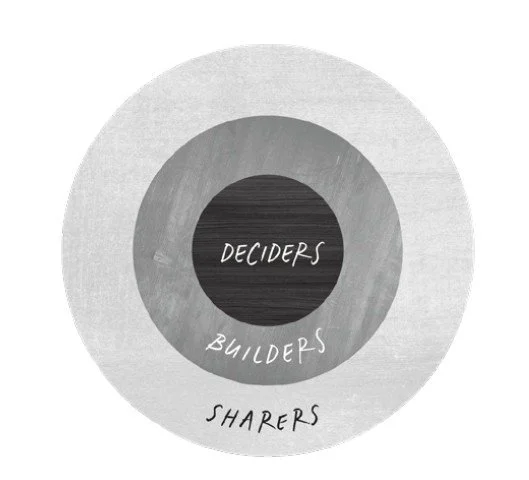
ID: Three concentric circles, Deciders in the center, Builders in the next circle, Sharers in the outermost circle
Deciders make the ultimate decisions and manage the project
In the center are the Deciders. This might be the Executive Director, Head of Operations, Board Chair, or a small strategic planning team. That person or group is the ultimate decision-maker in the process, and has the most power in planning. During the most intense phase of Inclusive Strategic Planning, we, as facilitators, meet with the Deciders every other week in order to keep the project’s momentum going and not lose energy.
➔ One Executive Director who served as a key Decider for their project shared that during the most intense phase of planning (lasting about four months for this organization), he allocated a day each week to strategic planning. This time included planning meetings, conversations with board and staff about planning, and reviewing and revising pieces of the Strategic Plan as they were created.
Builders create the vision
The next circle is the Builders: the staff and board members who will create the vision by participating in the strategic planning retreat and possibly some goal setting and implementation meetings. Subgroups typically grow out of the Builders, such as a design team or strategic planning task force. We meet with them at least once before the retreat to get their feedback on the strategic planning retreat agenda.
➔ Builders may devote an average of an hour or two weekly to strategic planning over a number of weeks, in addition to attending a one- or two-day strategic planning retreat.
Sharers share their perspective
The last circle is Sharers: The wider group of community members who will offer their perspective by participating in the Discovery step via interviews, focus groups, and surveys.
➔ Sharers are typically consulted just once in the process, making the time investment a total of 30–90 minutes.
While all groups are important in Inclusive Strategic Planning—and, in fact, the inclusion of these three distinct groups is what makes the process unique—it’s the two innermost concentric circles who are most actively involved in decision making.
How many people are in each circle?
Our experience is that for efficiency of decision making, it is difficult to have more than two to five people in the Deciders circle, since we meet with this group every two weeks during the most intense phase of Inclusive Strategic Planning.
The Builders, who attend the strategic planning retreat, might include the whole staff and board of an organization. In one case, this group was almost sixty people. This group needs to be able to fit in a room and work collaboratively to build the vision of the organization together.
The outermost Sharer circle can be a much larger group sharing their perspective in data collection, potentially including board, staff, partners, community members, and clients.
You might see yourself in one of those circles, as a Decider, Builder, or Sharer. Regardless of where you might be professionally or personally, I’m hoping you might lean in a little more in the last one and share a bit about the book with your networks! I only half-kid, of course, because I think this is an important resource for businesses, nonprofits, educational organizations, or even for you in your personal life. Generally speaking, inclusive processes make life better!
However, this book is geared more for nonprofits, because that’s what inspired it: Our experience working with nonprofit leaders. We have an opportunity to find ways for many people’s voices to be heard as we plan for the future of our organizations. I’m excited about helping leaders to do that – and I hope you’ll consider sharing to get the word out.
My next post will share another excerpt from the book. As always, I’d love to hear what you think - about the book, the newsletter, or anything you might need help with. Don’t hesitate to be in touch.