
How are you?
We were thrilled to observe the “blue tsunami” in the U.S. midterm elections last week. There were many thoughtful analyses coming out of the election.
This one from LaTosha Brown, cofounder of Black Voters Matter Fund, was inspiring:
“I believe that we saw on Tuesday a harvest of the seeds that were planted on fertile ground; we once again saved America from herself. In the South, we have been underinvested and underfunded.
While they have resources on their side, we have people on ours. The Beloved Community that Dr. (Martin Luther) King talked about; I also believe in the Beloved Community. I also believe that there can be an America that has space for all of us. (As much as I work in politics) I don’t think that this nation will be saved by its politics…I believe it will be about us leaning into our humanity.”
What powerful words! In our work, we keep talking and writing about an America that “has space for all of us.” We also design conversations that support organizations to lean into their humanity.
This can mean a lot of different things. Here are some practices that are part of every process we lead:
Listening to a variety of perspectives in planning
Including those who will be doing the work in visioning and goal setting
Making power in an organization visible
Making information visible and transparent
Including financial information in planning
Thrillingly, we are hearing from many nonprofit, government, and foundation leaders who also want to lean into their humanity and the humanity of their team members, board, clients, and partners, and are reaching out to us to design processes that do this. You might be one of them—if you are, reach out, we would love to hear from you!
The humanity of implementation
Through leading many strategic plans, leadership retreats, and board retreats, we notice that it is often easy to come up with good ideas. The more challenging part comes with implementation: determining who, exactly, will carry them out, and if the staff actually has the capacity to do this.
Fortunately, there is a way to make work visible, which helps clarify the details of whether and how a strategic plan can be implemented.
One key component of implementation is creating an action plan, which we wrote about here. In brief, team members ask some key questions about what success would look like, and then work backwards to create intermediate steps to accomplish that success.
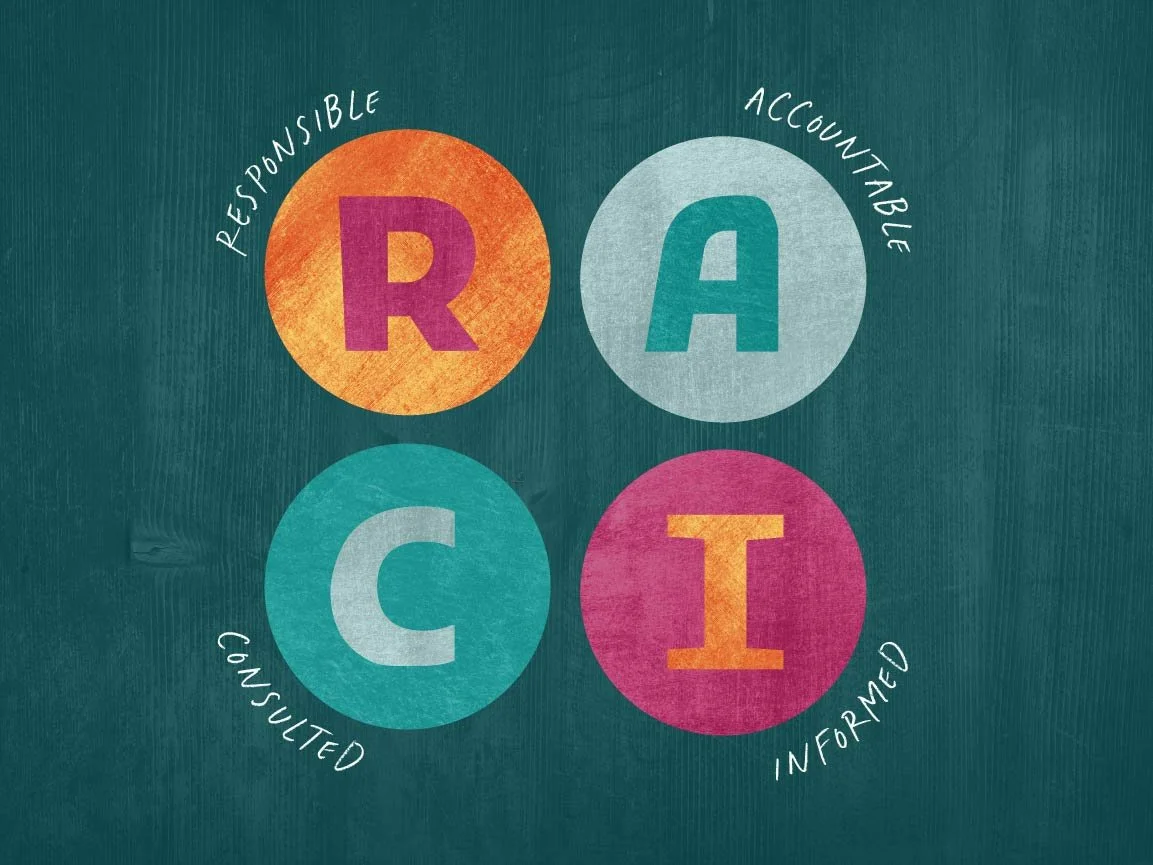
ID: Four circles with the letters R, A, C, I - around each the words Responsible, Accountable, Informed, Consulted
How the RACI matrix supports implementation
After learning about the RACI matrix a few years ago, it became a go-to in our toolbox and shared with future clients to support their work implementing their strategic plan. RACI—which stands for Responsible, Accountable, Consulted, Informed—is a process to identify the roles involved in a particular project.
It’s important to be clear on the definitions of each of these:
Responsible: The person or people doing the task or project. There must be at least one person responsible. This might be a program lead or crew lead.
Accountable: The person who delegates the work (to the Responsible person), and reviews this task to confirm that it is complete. Unless there’s a special circumstance, there should not be more than one person accountable for a task or project. This might be a department head or team lead.
Consulted: Provides input on the task due to their expertise. This might be the legal or human resources counsel.
Informed: Is kept in the loop on progress of the project or task. This could include board members, partners, or clients, as necessary.
How to create a RACI matrix
A RACI matrix is a spreadsheet. Here are steps to set yours up:
Identify all of the projects or tasks involved in implementation and create a row for each, listing them on the left side of the spreadsheet.
Create four columns: Responsible (R), Accountable (A), Consulted (C), and Informed (I).
Identify who is responsible, accountable, consulted, and informed by filling in names of team members in the cells for each row.
Using the RACI matrix
Once you have set up your draft RACI matrix, you need to review and analyze the information in the spreadsheet. Here are some questions to consider:
Does every task or project have one person Accountable, and no more than one person Accountable?
Looking at team members’ roles and responsibilities, is this doable? After completing their draft RACI matrix, one of our clients found that the Executive Director was now Accountable for 15 new projects! He did not have the capacity for this. Making this visible led to a conversation about shifting team responsibilities and possible hiring to support key initiatives in the strategic plan.
Are team members in agreement with this project plan? What support or accountability do we need to move this forward?
Ideas can be fun and invigorating to come up with, but without implementation, they can’t take your organization forward. Using the RACI matrix leads to better planning and accountability to make sure implementation is realistic within the constraints of your organization and your people.
Do you want support with revisiting a current strategic plan and clarifying implementation of the plan? We are leading some shorter-term engagements for organizations who want to spend a day or two clarifying next steps for a current strategic plan. Reach out, we would be happy to discuss further.