
Do you ever have those unpleasant tasks that you’re avoiding? If you're a human being, you probably have a couple of them on your to-do list.
We had one of those tasks on OUR list…for a while. For context: over the past year, we’ve published a series on Nonprofit Lifecycle. It started with Idea, then went to Start-Up, Growth, Maturity, Decline and Turnaround.
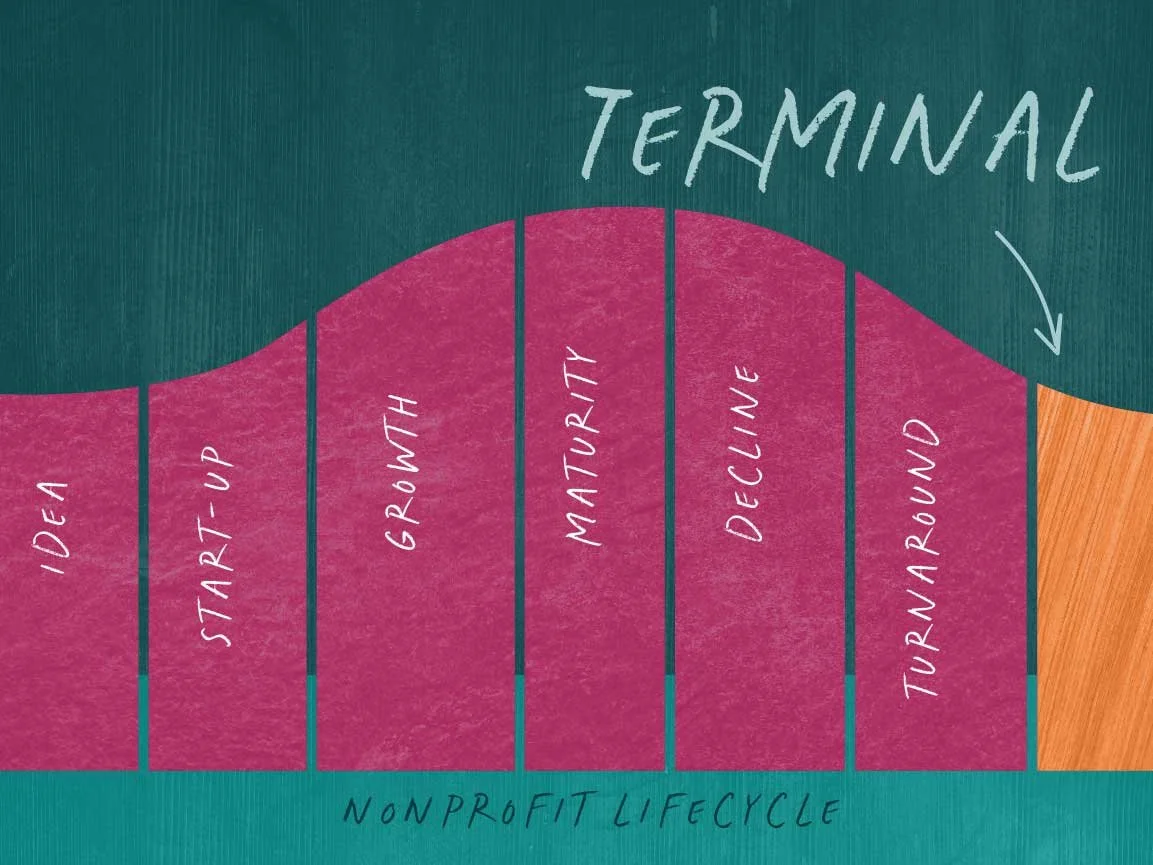
ID: Nonprofit Lifecycle in pink, with the “Terminal” panel emphasized in orange.
You’ll notice the image has a blank space remaining. That’s the final stage: Terminal.
I have avoided writing this Terminal post for a while. One reason is that The Ross Collective does not often work with nonprofits at this stage; most of our clients are in the Growth or Maturity stage. At a deeper level, though? I prefer to write about organizations thriving, not organizations dying!
But I felt obligated to finish the series. So ultimately I did the thing I usually do when something feels hard: I reached out to collaborators for support. Through a colleague, I connected with Camille Emefa Acey, who leads The Wind Down, a consulting firm that “designs and offers tools, practices, and services to aid mission-driven projects and organizations in closing with dignity and care” and interviewed Acey about her work.
Below is what she graciously shared with me—and now, with you.
What is the Terminal phase of the Nonprofit Lifecycle?
The Terminal phase takes place when an organization ceases to exist. Most often, this happens when the organization no longer has the funds to continue operating. This may also happen when the organization loses a founder leader, or key leaders decide to step back or no longer have the energy to keep the organization running.
In her post, “A Good Day to Die: Some Reasons To Call It Quits”, Acey points out that there are a number of reasons that a nonprofit may close which may not be related to loss or failure. For example, some organizations close down when they have succeeded in their mission, find that the organization is not in the right form to do its work going forward, or are no longer needed.
A “Good Ending” creates clarity and honors the work that has been completed
One of the most helpful takeaways from our conversation was the idea of a “Good Ending” of a nonprofit organization or foundation. Acey pointed out that whatever the reason for closing, it is so important to have a “Good Ending” when possible. This might include bringing staff and supporters together to honor the work that has been accomplished.
Acey shared that her favorite type of closure is an “intentional closure.” This may be related to a set-time period for achieving the stated goals of the organization. One example is Watershed, which launched as a ten-year initiative to provide access to clean water and sanitation in Cambodia. Watershed committed to working for ten years exactly. At the end of the ten years, leaders celebrated their work and accomplishments by documenting their model and work towards systems change.
As Acey pointed out, “People don’t see Good Endings enough…they usually see the ‘Crash and Burn Ending’.” In Acey’s view, a Good Ending may include:
Committing financial resources to the closure
Employees treated well and resourced for their work transition
The community is clear on what happened
Communication to larger ecosystem
Sharing learnings, and commemorating what was accomplished
Honoring the connections that people have with each other
Archiving the work and sharing materials so that others can learn about what was accomplished
Acey emphasized the importance of setting and communicating strict deadlines, i.e. “We will no longer be in operation after October 31, 2026.” This lets clients, staff, volunteers, and partners know that the organization will not be there after that deadline.
Thinking in terms of Nonprofit Lifecycle
The lifecycle approach draws on the natural lifecycle. The underlying assumption is that there is (in the words of Ecclesiastes, or The Byrds) “a time to be born…a time to die.” Nonprofit organizations often emerge from a specific time and need; as the times and needs change, it may be time for the organization to end its work. There does not need to be a stigma around an organization winding down.
Key steps to winding down an organization
Acey explains that legal requirements for closing down a nonprofit organization vary by state. She encourages leaders to research the specifications for their particular area.
Commonly, a wind down includes distributing the assets of an organization, which could include selling or giving property to another organization, or moving a key program to another organization.
What you can do now
No matter where an organization is in the Nonprofit Lifecycle, board and staff can engage in succession planning and emergency planning. Done right, this gives leaders the opportunity to discuss how they might react to possible scenarios and to have a plan in place if an unexpected shift or emergency occurs.
It is also important for leaders to do frequent, effective, proactive financial planning and scenario planning. When an organization winds down, the roots of the closure sometimes are found in leadership taking on excessive risk or failing to plan for and manage financial shifts.
Do you need support bringing leaders together to build alignment, get on the same page, and determine how to be proactive in the face of shifts? Reach out, we’d be interested to speak with you.